Saturday, April 1, 2017

7-Day Lake Superior Motorcycle Route


Yes, this is a huge departure from my usual topics, but enough of my friends are interested in adventure motorcycling that I consider it a worthwhile post.

Having done the Lake Superior loop on my motorcycle twice now, I've learned several lessons that may prove to be useful for others embarking upon the ride.

The first lesson is a simple one; go clockwise. This offers two advantages. First, you'll be on the side of the road that's physically closer to the actual shoreline. This offers slightly better views.

Second, and more importantly, it's safer. Why? There are many scenic turnoffs along the way, and if you're riding clockwise, you can simply pull off the road and pull back on without ever having to cross oncoming traffic. You simply duck out of and back into your own lane of travel.

Here, then, is a route optimized to start and end in Ann Arbor, Michigan. Because that's where a buddy of mine will be riding from.

DAY 1: Ann Arbor, Michigan to Munising, Michigan


Overall, one of the most boring days of the trip, this day serves one purpose - to get up to Lake Superior. Probably the only truly interesting part of the ride is the ride over the Mackinac Bridge. In addition to the incredible views, motorcyclists will find the inside two lanes of the center span particularly interesting, as they are comprised of steel grates:

Source: https://bobistheoilguy.com/forums/ubbthreads.php/topics/3516471/Driving_on_a_metal_grate

The center lanes of the bridge stand approximately 200 feet above the water, and you can see straight through them when you look down at your feet. In addition, your motorcycle has the tendency to constantly squirm left and right as you ride along.

Source: https://greatlakesgazette.wordpress.com/2012/11/01/happy-birthday-mackinac-bridge/

Try not to think about the 1989 accident in which a woman was killed when the Yugo she was driving was blown off the side of the bridge:


Day 1 ends in Munising, where there are two available campgrounds. The nicer one appears to be the Bay Furnace Campground, on the shore of Lake Superior. I have yet to stay at either one, but both seem to be pretty solid places to stay on the first night.


DAY 2: Munising, Michigan to Copper Harbor, Michigan


Day 2 takes us from Munising up to Copper Harbor. The first 2/3 of this ride is fairly boring. After that's over with, however, it becomes very cool very quickly, with food stops like this in abundance:


Houghton, Michigan is a pretty cool town with good restaurants, nice views, and an impressive vertical lift bridge.


After passing through Houghton, you'll see some roadside firewood shacks where you can purchase cords of firewood and kindling. I recommend picking a couple up for a campfire later.

About 30 minutes outside of Copper Harbor, my preferred route diverts up to M-26, through Eagle River and Eagle Harbor. This stretch of M-26 is absolutely stunning. The pavement is in great shape (although one must watch out for sand scattered everywhere) and you're treated to constantly rolling curves along the lakeshore.

That's a giant Olympic-sized ski-jump way off on the horizon:


Upon approaching Copper Harbor, my route snakes up Brockway Mountain Drive, a small road that progresses along a high ridge before descending down into town:


Lodging in Copper Harbor may be dependent on the weather. If the weather is good and the ground isn't too waterlogged, you'll want to progress all the way out to the very tip of the Keweenaw peninsula to camp. Doing this necessitates a 7-8 mile drive along a rather challenging logging road, all the way past the very end (or beginning) of US-41.  The majority of this section can be nearly impassible on a motorcycle that lacks ground clearance and knobby tires:


The photos above show a more tame section of the road. While the road can be negotiated by any four-wheeled vehicle with sufficient ground clearance, it can be quite sketchy on two wheels after a rain. Large sections of the road can be completely submerged, hiding rocks and large potholes. And the mud can make things very slick.

Along the way, there's a turnoff to a place known as the Keweenaw Rocket Range. There's nothing there, really, other than some concrete pads and this monument:

Source: http://www.panoramio.com/photo/34568235

The reward for reaching the very tip of the peninsula is significant. Upon reaching High Rock Bay, you will be rewarded with stunning views and some well-established campsites with good fire pits:


The last time I was here, the wind was rather extreme and it took a bit of effort to set up my tent by myself. The wind also nearly prevented me from getting a campfire going. Although I had a blast sitting out on the beach at 2am and watching the northern lights for over an hour, I would consider setting up camp in a more sheltered location if high winds are a factor.

The place to do so is on the southeastern shore of Schlatter Lake. The tiny road to get there isn't marked, but you should be able to find it. Protip: I've found that Bing Maps provides more detail in this area than Google Maps.


There, you'll find a big area completely sheltered by tall pine trees with a nice lake view. Former campers were even thoughtful enough to set up several big sections of tree trunks to use as tables and ottomans:


If you've conquered the road out to High Rock Bay, your machine will likely be adorned with several layers of cool looking, iron rich red mud:


So those are the options if you're willing and able to tackle challenging, muddy terrain on your motorcycle. If you're less keen on the idea, or are unable to do so, I strongly recommend renting a small cabin at the Bella Vista Motel back in Copper Harbor. I've stayed here twice, and really enjoyed it each time:


There are some good restaurants in town. My favorite place to go isn't a restaurant exactly, but rather a coffee shop/bakery/smoked fish shop just a few blocks from the cabin called Jamsen's Fish Market. Protip: jot down their wifi password so you can stroll over and enjoy quick internet even after they close for the night.


This other motel in town looks like it's straight out of a Stephen King novel:


DAY 3: Copper Harbor, Michigan to Herbster, Wisconsin


Day three will involve about five hours on the road. You'll want to get an early start because your lunch/dinner venue often closes at 4pm. The first half hour and last hour will be great. Most of the rest will be rather boring.

Take 41 out of Copper Harbor and enjoy 20-30 minutes of great sweeping curves through tunnels of trees. Swing back through Houghton, and pass by old reminders of the once-bustling copper and taconite mining industry:


Then sit back and watch the miles tick by as you approach the absolutely legendary Delta Diner


The Delta Diner is incredible. The people are amazing and so is the food. I had salmon and eggs for breakfast and loved it. They don't accept tips. Instead, their food is priced a bit higher than, say, Denny's, and they pay their employees a minimum of $15/hour with benefits. Accordingly, the employees all seem really happy working there and obviously take a lot more pride in their work than you might expect.

There's a coffee shop adjacent to the diner, too, so you can fuel up with some dark-roast octane before getting back on the road. Be sure to check the hours of both the restaurant and coffee shop before heading in, as they often close at 4pm...and one day a week, their closing time varies.

After great food and strong coffee, head north via 236 through the Moquah Barrens State Natural Area. 236 is an odd little road, and much of it feels like you're on a private driveway. It's a fun stretch.


After about an hour, you'll arrive at one of the Lake Superior Circle Tour's best-kept secrets....the Herbster Campground. This place is great. You can camp right on the shore of the lake and enjoy an awesome sunset. The beach is great for swimming. There's a really nice, helpful couple in charge of the place who live on site. They sell cords of firewood and keep the place really clean.


The campground has wifi, believe it or not. And last year, they added a small trailer with men's and women's showers. Protip: bring a 5-10 pound item and a carabiner so you can hang the item onto the shower pull chain and enjoy a steady stream of water. 

If it's rainy when you're there, no worries. They have a covered pavilion. You can't camp in it, but you can sit at a picnic table out of the rain, enjoy a meal, and use one of the power outlets to charge your things up.


If you're not in the mood to cook your own food, there's a restaurant about 1/2 mile down the road that people seem to love.


DAY 4: Herbster, Wisconsin to Sleeping Giant Provincial Park, Ontario


Finally, a border crossing! Sure hope you remembered to bring your passport and leave your guns at home. One would think that Canadians, of all people, would appreciate the value of having personal protection at your side when traveling through remote wilderness. But no.

Get an early start in Herbster, because today's route has a way of eating up a lot of time with roadside distractions. The first such distraction is the city of Duluth in general, and the Aerostich headquarters in particular.


If you're unfamiliar, Aerostich is a manufacturer of world-renowned armored, weatherproof motorcycle suits. In addition, they're a very well-respected outfitter of adventure motorcycle gear. I particularly like the area shown in the photo above, where adventurers can spread out across many tables to relax and plan their route. It's a great place to chat with other riders and trade intel on your routes over a cup of coffee.

I have an Aerostich Transit leather jacket and pants that I love. They are 100% waterproof, courtesy of Gore-Tex....yet, so breathable you can see right through the perforated leather:


Unfortunately, they stopped offering leather gear due to the cost of the material.

Downtown Duluth is cool. It's got an old iron-belt feel with nice restaurants and a museum ship you can explore:


From Duluth, it's just under three hours to the Canadian border. It's a nice ride along the shoreline, with several nice scenic turnoffs. Here, you'll begin to appreciate the clockwise nature of the route, as you'll be able to effortlessly peel off and merge back into your lane of travel without having to cross oncoming traffic.


Even the pizza shops begin to take on a distinctly Northern feel as you approach Canada:


Just outside of Two Harbors, MN, there's a cool hotel that's built into and around train cars, the Northern Rail Traincar Inn. I stayed there once and really enjoyed it. 


The timing/schedule of this particular route doesn't lend itself to using this place as an overnight stop, but I thought it was worth mentioning.

One of the many scenic turnoffs along the Minnesota shoreline:


The border crossing will likely be pretty uneventful, provided you aren't carrying any weapons or pepper spray. I make a point of removing my helmet and sunglasses whenever talking with the customs agents, mostly out of respect. Nobody likes talking to someone they can't see, after all.

Speaking of law enforcement, you'd be wise to avoid committing burglary in Canada, as it can result in imprisonment for LIFE:


From the border crossing, you'll have just over an hour of highway travel through Thunder Bay before the 30-40 minute trek into Sleeping Giant Provincial Park. This is a great little road that's plenty of fun. Watch out for deer and other wildlife, though, and keep your speed down so you'll be able to brake in time if needed.


The park itself is quite nice, as are all of Ontario's Provincial Parks. The campsites are all fairly private, cords of firewood are available for purchase at the park's entrance, and they offer fantastic hot showers that are kept very clean. 


A note about Ontario's Provincial Parks - their website is great, and you'll want to use it to book your campsites as early as possible. You'll be able to view photos of specific individual campsites and book whichever you prefer. I recommend booking all of your Canadian campsites in one go. You'll then be able to simply show up and be directed to your reserved site.


DAY 5: Sleeping Giant Provincial Park, Ontario to Neys Provincial Park, Ontario


Day 5 is a one of the shortest days of the week, mileage-wise. There are a few reasons for this. There are some great waterfalls along the way outside of Ouimet, and although I have yet to visit them, people seem to rave about them. Not far away is a canyon offering zipline tours which I also have yet to try.

But before getting to that area, it's worth cruising through the tiny hamlet of Silver Islet, a former mining town. Turn right out of the campground, ride for about 5-10 minutes, and bear LEFT when given the option. This will take you clockwise along the one-way road through "town", which is an eclectic collection of houses, all powered by wind or solar power.


After cruising through this former mining town, head back north to exit the park and get back onto the Trans-Canadian Highway. When you've ridden for about two hours, you'll approach the tiny town of Rossport. There, you'll find a pleasant little restaurant called Serendipity Gardens. It has a very European feel and fantastic fish.


You'll have a nice view of Lake Superior as you devour your lunch:


The last hour or so will provide you with sweeping views of the lake as you carve through roads cut through cliffs and hillsides. Fortunately, you'll only have to suffer an hour of riding with a stomach filled with fresh fish.


Neys Provincial Park is another clean and enjoyable Canadian campground. Pick up a cord or two of firewood and head on in to your campsite.


After setting up camp, you'll be able to walk about 100 feet to the lake and enjoy a refreshing swim.


DAY 6: Neys Provincial Park, Ontario to Agawa Bay Campground, Ontario 


Day 5 is another relatively short ride, which will allow you to relax and spend time enjoying what is perhaps the nicest campground on the Canadian side of the lake, Agawa Bay.

The ride itself is nice, however, and offers plenty of scenic turnoffs.


Along the way, about 30 minutes west of Wawa, there's a place called the Normandy Lodge with A-frame cabins and a motel. AVOID THIS PLACE:


It looks all nice and quaint, but there's a problem. After dark, when you turn the lights on, you'll discover that the window screens are not effective. At all. So all the mosquitos within a 30-mile radius become attracted to your lit-up cabin and infiltrate in vast, vast numbers.

You then find you're relaxing in what amounts to a giant bug zapper...except, instead of attracting the mosquitos and then zapping them, you're attracting them and then rewarding them with gallons of your sweet, sweet blood.

The cabin quickly fills with an ever-increasing amount of buzzing, winged death until, in a panic, you throw on your motorcycle helmet to avoid breathing them in and run to the main office in a blind panic. There, the admittedly friendly staff kindly relocates you to one of their motel rooms that lacks drinkable water.


So yeah...avoid the Normandy Lodge and proceed onward to the comparatively idyllic Agawa Bay Campground.

I stayed at campsite #235 and highly recommend it, as it is positioned right on the beach but also has great shade and a fresh water tap nearby.


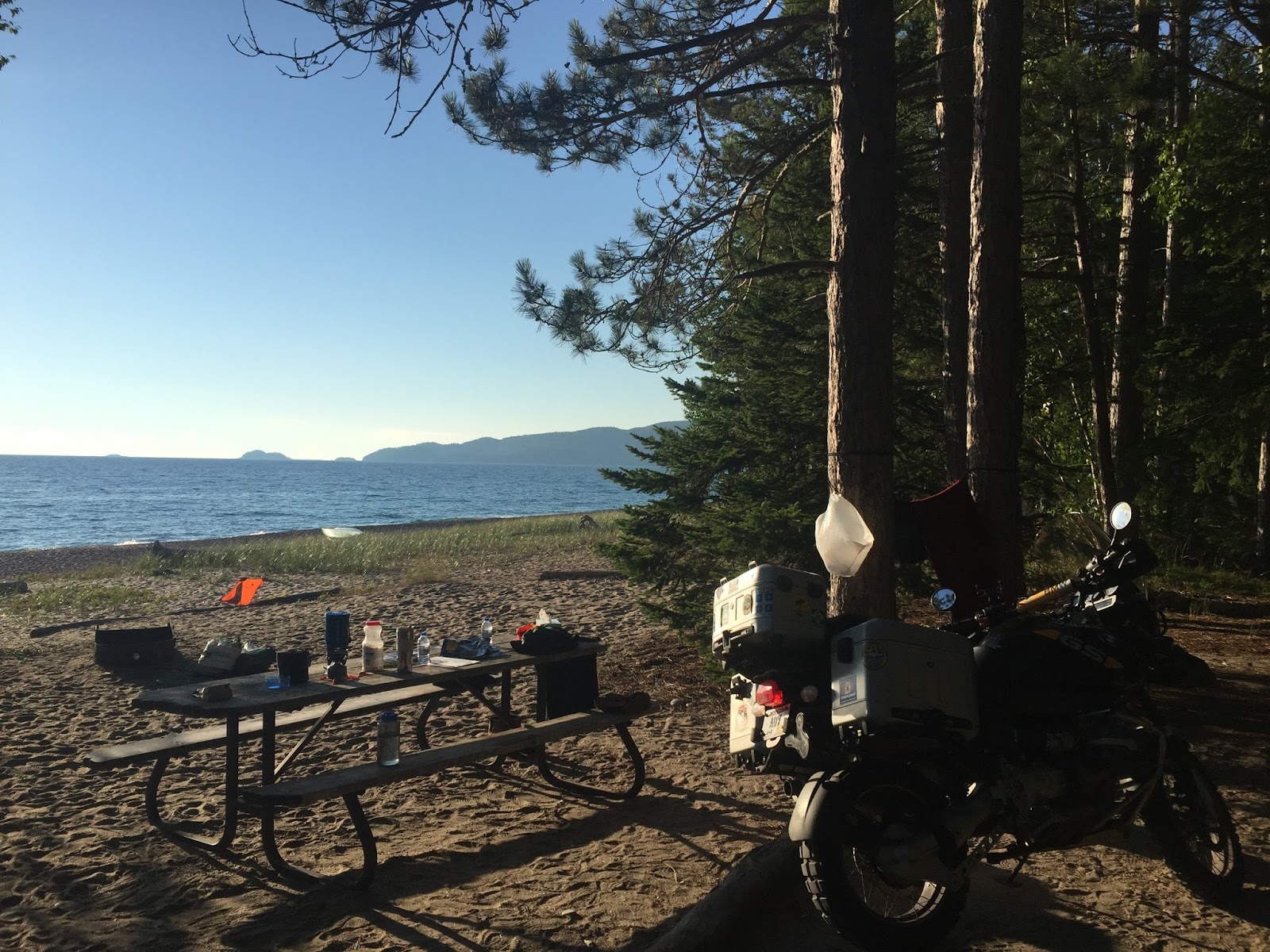


 Be sure to bring food, however, as there are no stores anywhere near this campground.


DAY 7: Agawa Bay Campground to Ann Arbor, Michigan


The final day is always the worst. It's 6.5 hours long and lacks any of the excitement and anticipation of embarking upon the first day of an adventure.

The last bit of Canadian shoreline has some great sights, however:


Be sure to pick up some Canadian-specific goodies to smuggle back into the States:


I definitely recommend stopping off on the US side of the Soo locks in Sault Ste. Marie, Michigan. There, you can relax for a bit and watch giant, 1000 foot long iron ore freighters proceed through the locks. There's a nice park right next to the southernmost lock with an elevated observation platform. This allows you to observe these giant ships glide by about twenty feet away. Definitely worth seeing if you've never experienced it.

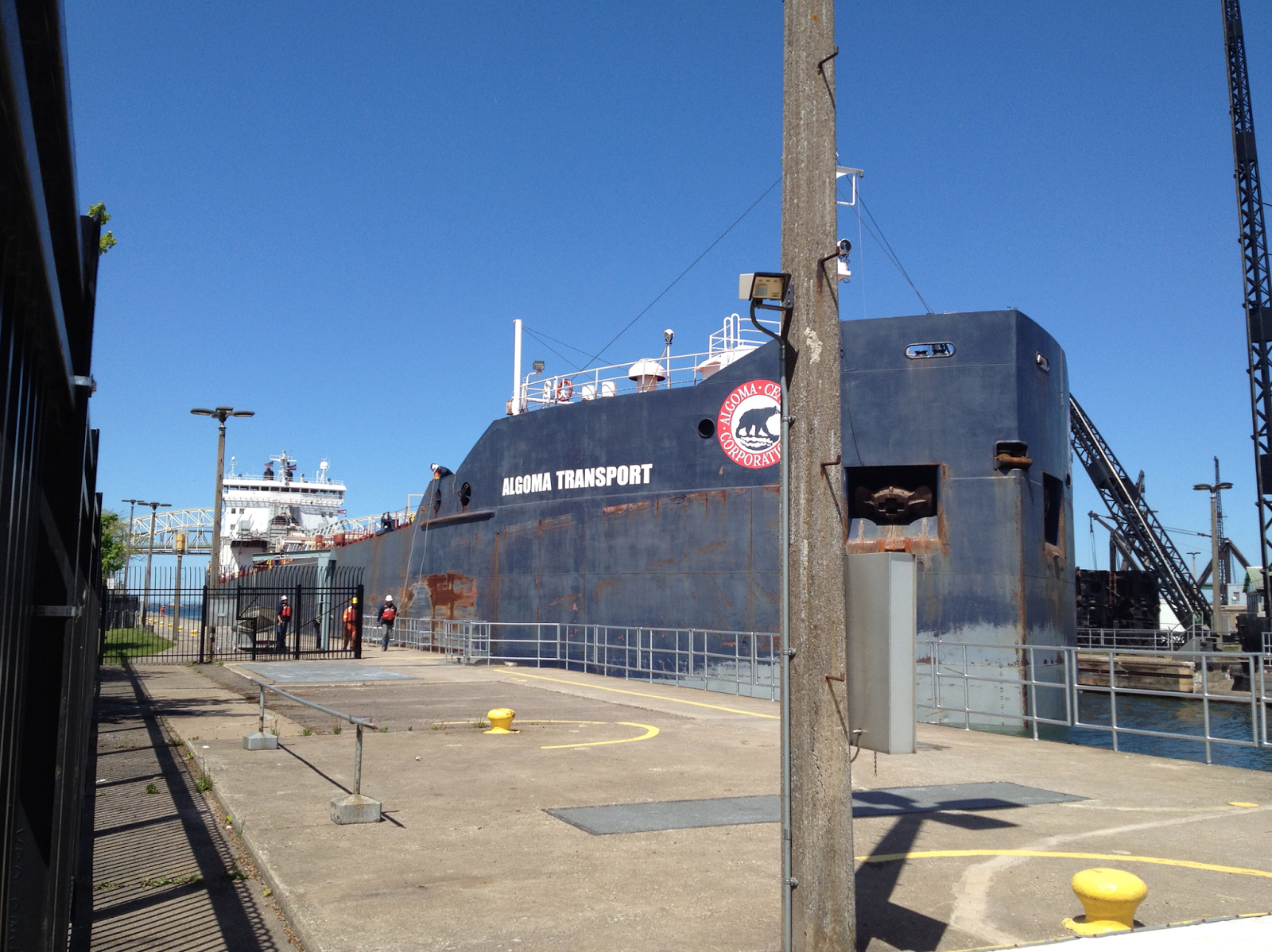


Notice the difference in the water level of Lake Superior....


....versus that of Lake Huron:


Parks and campgrounds down the street offer additional views of ship traffic:


Finally, (if you're headed back to Michigan), you'll get to enjoy another bridge crossing:


From there, queue up some podcasts and think about sleeping in your own bed. You'll be looking forward to it on the way home!

If you've enjoyed this review and decide to give it a go, please return and share your photos and recommendations. And have a great trip.

Tuesday, February 7, 2017

VC-10 Tip Tanks

Apparently, the Vickers VC-10 was initially intended to be equipped with tip tanks:


There seems to be very little information available about the initial tip tank design. A model aircraft forum, however, has featured photos of a model with tip tanks:


Otherwise, the only example I can find is a freighter concept with a swing-away nose:


Apparently, tip tanks aren't always the most beneficial means of extending an aircraft's range. Some Gulfstream IIs were so equipped, but rumor had it that the added drag actually resulted in a net decrease in range. And some sources report that, among fighter jets, approximately half of the fuel contained in external drop tanks is used to compensate for the added drag of the tanks themselves.

It's possible these factors combined with the likelihood of damage from ramp vehicles and equipment to kill the VC-10 tip tanks before it reached fruition. 

Wednesday, February 1, 2017

Tupolev Tu-144 Charger SST For Sale

It was a standard Tuesday night. Out of boredom, I was scouring eBay for bizarre aviation memorabilia. Naturally, it was only a matter of time before I entered "crop duster" as a search term.

After sifting through the hits and finding nothing particularly noteworthy, my eyes drifted down to the "You might also be interested in" section, and there it was. A Tupolev Tu-144 Charger SST jet. It could be mine for only 7.5 million bucks. Provided I'm the only bidder, that is.


Other than the presence of a wing and categorization as an aircraft, it's anyone's guess how this aircraft is related to crop dusters. But I was glad to have happened upon it. Only sixteen Tu-144s were built, all between 1963 and 1983. It was essentially a very poor copy of the famous Concorde, with a vastly inferior wing and more primitive systems.

Considering the dismal state of today's used market for supersonic passenger jets...and let me tell you, it's truly dismal...beggars can't be choosers. And this particular aircraft is the only real option at the moment, even for the most discerning shoppers.

СССР-77107, as it is known, made its first flight on August 20, 1975. Not surprisingly, it flew for Aeroflot, primarily serving as a test aircraft. It's final flight occurred in 1985, when it was delivered to its present location - Kazan, Russia.

Despite it's dirty and poorly-maintained outward appearance, some creative Googling revealed more photos that began to make me feel better about the condition of the Tupolev. As you can see, snow is periodically shoveled off of the immense delta wing by local caretakers:

Source: http://orbicraft.livejournal.com/11268.html
Additionally, the aircraft actually has relatively little use. Over the course of ten years, it logged 180 flights and 357 flight hours. Of those flight hours, only 135 were spent in the supersonic flight regime. With numbers like this, it would almost be irresponsible not to purchase it. 

That said, Russia being Russia, I can only hope it wasn't operated into and out of fields of snow and mud with livestock, sacks of potatoes, and bales of straw crammed into the passenger cabin.

But still, you want to investigate a $7.5M purchase as thoroughly as possible. A closer look at the eBay listing reveals very little information and I noticed multiple red flags. And I'm not talking about the ones painted on the tail. The eBay shopper is provided with no engine times, no cockpit photos, no cabin photos, no maintenance logs, etc. If ever there was a textbook case of Caveat Emptor, this would be it.

In fact, the rest of the eBay listing raises more questions than answers:


The seller claims to be a successful broker of Russian space stations and satellites, which I suppose makes him more qualified than most to deal in obsolete, derelict Russian supersonic transport airliners. But other aspects of the ad raise even more red flags. The aircraft is not eligible for the eBay vehicle purchase protection programs, and despite having a bit of equity in my home and just a small amount of outstanding student loan debt, I was not able to secure "low monthly payments", as the listing promises. For me, this would have to be a cash-only transaction, likely involving several suitcases and multiple armed guards.

On the other hand, the listing states that the price "will include all costs for delivery, including a Russian team to come to America for complete assembly." I've never attempted to assemble or ship an obsolete Russian SST, but having some experience with Ikea and several plastic model aircraft, I'm sure that service is worth a half million or so all by itself.

Indeed, I was fully prepared to arrange a meeting with the esteemed Russian spacecraft broker. That is, until then I saw his eBay seller profile:


You're reading that correctly. OasisRob1945 has virtually no feedback whatsoever. The man wants to be a broker of supersonic airliners, and yet, he's only ever sold a single item on eBay...an 8' inboard hydroplane. 

And so, with that discovery, any and all credibly on the part of OasisRob1945 vanished into thin air more quickly than this beautiful supersonic steed did at max cruise speed back in it's day. And with it, any prospects I once had to become the world's newest SST owner and operator.

Wednesday, October 15, 2014

NIFA Memorabilia in the Smithsonian

The National Intercollegiate Flying Association dates back to 1920. In all those years of intercollegiate flying competition, many awards have been presented, usually in the form of traditional trophies.

The organization has occasionally gotten creative in that respect, however. Back when it was known as the National Intercollegiate Flying Club, these wings were handed out:


It's unclear what specific purpose these wings served...whether they were a specific award, whether they were handed out to judges, or whether everyone received a set.

Whatever their purpose, these particular wings are now part of the Smithsonian's collection.

Saturday, November 17, 2012

Associated Press Takes Sensationalism to a New Low

The Associated Press has stooped to a new low. 

On Friday, November 16th, a Cessna 172 was involved in a crash in Owl's Head, Maine that claimed the lives of three people. Tragic, to be sure. But to the associated press, perhaps not tragic enough.

This is a Cessna 172:


...and this is the photo the AP decided to run with the story:


See that twisted airliner carcass? Not only does it have absolutely nothing to do with Friday's Cessna crash in Maine...it has nothing to do with any crash whatsoever. It is an old airliner fuselage being cut up and used for scrap metal.

But, apparently, the AP needed to frame the Cessna accident in as bloody a manner possible. Here are some additional bits of unnecessary sensationalism from their story:


"spiraled out of control"

"immediately burst into flames"

"With flames shooting 10 to 20 feet in the air and smoke billowing into the sky, the first people to the scene tried unsuccessfully to pull one of the occupants from the burning wreckage"

"The flames were hot enough to pop the airplane's tires"


Reporting can be accurate and factual without resorting to such blatant, obvious, and pathetic attempts to sensationalize such a tragic incident.

Perhaps it's time that the AP consider integrating taste and maturity into their reporting.


Tuesday, February 28, 2012

NIFA Aircraft Recognition - How it Works Behind the Scenes

Many readers of this blog (I estimate there to be as many as 4 of you) know me through the National Intercollegiate Flying Association (NIFA). I competed in three Regional SAFECONs, four National SAFECONs (1998-2002), and I've judged both for many years. I've also been known to write an Aircraft Recognition test or two, and I hope to stay involved for many years to come.

When I was a competitor, I had a lot of questions about how Rec tests are made, and what guidelines are followed by the test authors. For example, at what age is an aircraft model too old to be included in a test? Can WWI-era aircraft be included? Can unmanned aircraft be used? Are the aircraft types limited to production models? If so, how many examples must be produced for a given model to be considered "production"? In short, what guidelines are in place to control what aircraft types appear in a NIFA Rec test?

Having been involved in judging for several years now, I can tell you - there are none!

According to the rules, an author of a Rec test may include any and all flying contraptions. Technically, he or she may include autogyros, gliders, hot-air balloons, Zeppelins, ultralights, and spacecraft. Fortunately for competitors, such madness is reined in by two values held dear to the test authors - tradition and consistency.

NIFA is rooted in tradition (In more ways than one - browse this link when you have some free time). Those of us who write tests generally want to honor the past by continuing long-standing tradition. And we also want to be fair. If a change is determined to be prudent, we will do what we can to institute it in a gradual manner. This prevents confusion, and it enables teams to utilize the knowledge and experience gained from competition.

The latter point cannot be emphasized strongly enough. NIFA could quite easily introduce strict, detailed guidelines for test authors to follow. A thick, detailed volume resembling a Gleim study guide could be distributed so competitors would know precisely what can and cannot be included in a Rec test. While this would undoubtedly eliminate much uncertainty among the competitors, I am against the idea.

Here's why:

If we were to create and communicate specific guidelines for tests, a school could recruit a knowledgeable competitor off the street, bring them to the National SAFECON, and instantly produce solid results in a "turn-key" fashion.

I don't want to reward teams for doing this. And I don't want Aircraft Rec competitors to be able to excel by locking themselves in separate rooms and studying independently for months at a time.

Instead, I want to reward the teams that make the effort to A) learn knowledge and tradition from their senior members, and B) actively pass it down to new recruits. I want these new recruits to learn from books and online sources, but I also want them to learn from more senior team members who have been around the block a few times. This builds team spirit, cooperation, and cohesion. And it creates a much more fulfilling and memorable experience. In my opinion, this is the essence of what it means to be on a NIFA Flight Team.

Now, it should be stressed that this outlook is my own. Other test authors and judges will likely have varying opinions and different perspectives on the matter. But my approach seems to be appreciated by many, and I think it reflects values held dear to NIFA.

So in response to the questions at the beginning of this article, I would expect to see the same aircraft categories you're accustomed to seeing. If you and your senior team mates have never seen a spacecraft or a WWI-era aircraft on a Rec test, it's doubtful you will see any in future tests. If anything new is introduced, expect it to be introduced gradually. For example, if I decided to introduce gliders to Rec tests, I would start by including one or two on a test. Not by dumping 15 of them into a single test at once. And no, I have no plans to add gliders to any future test!

So that's a snapshot into the creation of Rec tests.

As a judge who is somewhat active on the social media scene, I also receive questions about the official model name and/or designation of certain aircraft. Whether "Dreamliner" the official name of the Boeing 787. Whether the manufacturer of certain ELINT types should be that of the original airframe manufacturer, or that of the modifying entity. What differentiates one type of GA single from another.

To this, I like to remind competitors that as much as I'd like to help, I am a judge and not a coach! I go by what is printed in the official NIFA source - Jane's All the World's Aircraft. To be specific, I interpret this as the Jane's "yearbook" series. One is published every year, and each edition lists two years on the cover, as such:


These books are heavy, fabric-bound, and can be very expensive. Generally, editions from the 1970s and 1980s are the least expensive, fetching $15-30 on Amazon (tip - create an Amazon "Wish List", add these books, and circulate the link among your family and friends). As they become newer or older, they also become more expensive. Editions from the 1940s or 1950s are often in the hundreds of dollars, and editions younger than ten years old can be several hundred dollars each. This reality forces those of us with limited funds to pry ourselves away from Google and visit *gasp* a physical library! Look at it as a team-building field trip and have fun perusing the pinnacle of aircraft knowledge together with your team mates. You will be amazed at what you discover, I assure you.

Hopefully this sheds some light on the inner workings of the NIFA Aircraft Recognition event. By all means, throw questions my way. Depending on the topic, I'll either refer you to the aforementioned Jane's, or I'll do my best to answer them.

Here's to the greatest NIFA event, and here's to the good times and good friends we encounter in the pursuit of it's mastery!

Wednesday, January 11, 2012

Mexico's Air Force to Replace Pilatus PC-7 Fleet with Beechcraft T-6C+

As reported by Jane's earlier today, the Mexican Air Force has announced the purchase of six Beechcraft T-6C+ aircraft to be used as military trainers. The aircraft will come equipped with hard points, enabling them to carry external stores and weapons, though the latter are claimed to be intended for delivering practice rounds only.

(Image: Hawker-Beechcraft)

What is unclear at this time is how the role of the new T-6 fleet will compare with that of the relatively new Pilatus PC-9M fleet (photo). Considering that the PC-9 and (soon to be retired) PC-7 fleets are both reportedly utilized for combat and counter-insurgency, it would be surprising to see the wholly capable T-6C+ fleet limited to training duties. Time will tell.

Monday, January 2, 2012

The Ultimate Aircraft Recognition Hobby Shop

The sleepy, rural town of Tecumseh Michigan has long enjoyed the distinction of being the self-proclaimed "Refrigeration Capital of the World". But as I discovered last week, 2011 may be the year where that exalted status has finally been overtaken by something even more grandiose.

I hereby nominate Tecumseh as the "Obscure Plastic Aircraft Model Capital of the World".

While I was back in Michigan for Christmas, I decided to visit a couple of the small airports in Tecumseh to see if there were any interesting aircraft types lurking about. It is, after all, where I discovered the Andrew Smith AJ-2. That search ultimately proved to be fruitless. But my appetite for unusual aircraft would soon be whet in an entirely different manner.

Drive down the main street of Tecumseh, and you'll find J-Bar Hobbies:


A quick glance at the unassuming exterior provides no clues to what treasures lay hidden within. One might expect to find models of B-17s, P-51s, and F-15s. Maybe even a Mig or two. But even the most seasoned and jaded aviation geek (particularly of the NIFA variety) will be stupefied upon discovering the bounty of such names as Myasischev, Culver, Temco, and Sud-Ouest:


So if you're ever heading into or out of Michigan on US-23 just north of Toledo, consider a 20-minute detour. Or head over to J-Bar's website and do some browsing online.